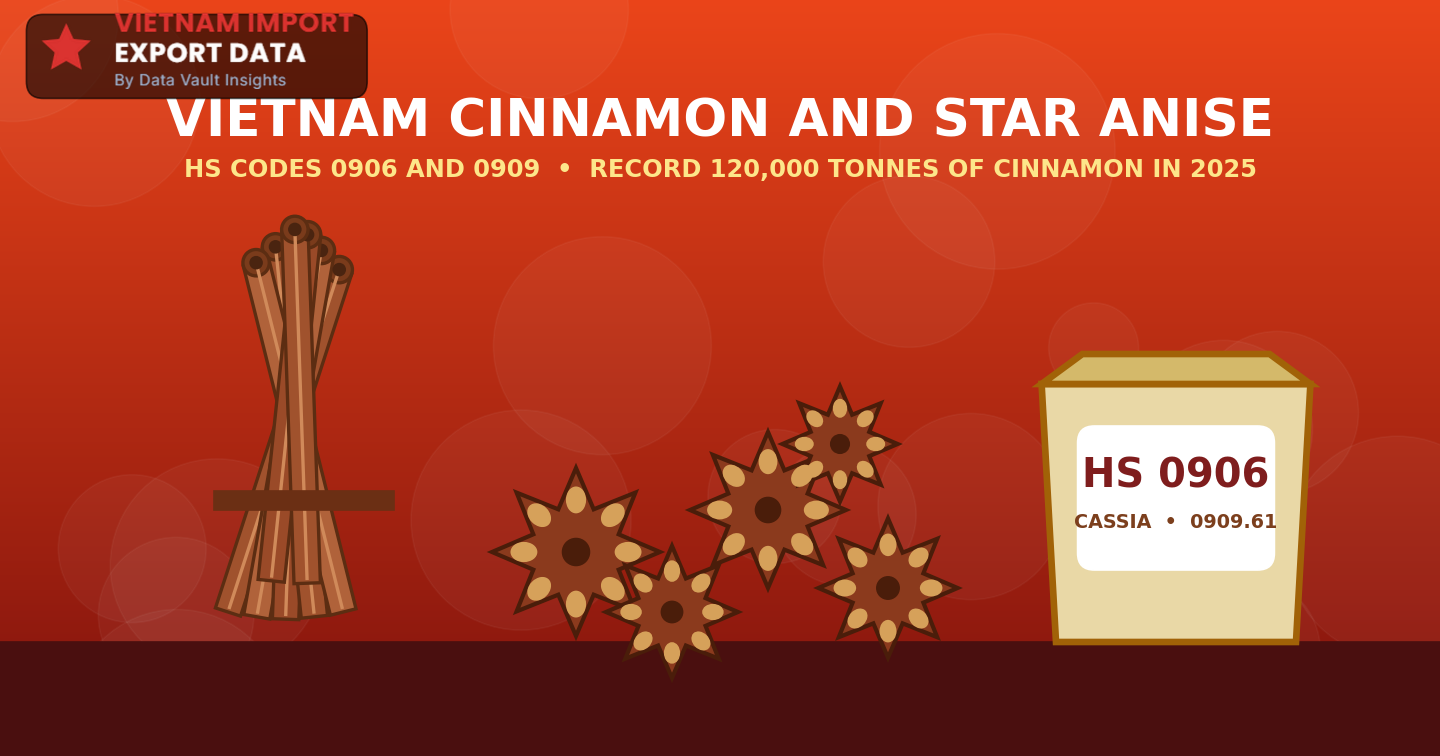
Pepper gets most of the headlines in Vietnam's spice trade, but two quieter products are growing fast: cinnamon and star anise. Vietnam is now the world's third-largest cinnamon producer after Indonesia and China, and it sells to nearly 100 countries. In 2025 it exported a record 120,295 tonnes of cinnamon worth US$300.2 million, up from 99,874 tonnes and US$274.5 million in 2024. Star anise is smaller, around US$50 million a year, but it is a specialty of the northern mountains.
For spice importers, packers and food makers, these two products are worth a close look. This guide explains HS codes 0906 and 0909, how cassia differs from true cinnamon, who buys Vietnamese spices and how to find exporters in Vietnam spice export data.

Vietnam Cinnamon and Star Anise: Key Numbers
| Product | Figure | Period |
|---|---|---|
| Cinnamon exported | 120,295 tonnes, US$300.2 million, a record | 2025 |
| Cinnamon exported | 99,874 tonnes, US$274.5 million | 2024 |
| Cinnamon exported | 73,080 tonnes, US$187.5 million (up 34.9% in volume, 21.6% in value) | January to July 2025 |
| Cinnamon exported | 73,085 tonnes, US$186.5 million (flat) | January to July 2026 |
| Cinnamon imported | 5,034 tonnes, US$11.3 million | 2025 |
| Star anise exported | 11,152 tonnes, US$52.6 million (down 13% year on year) | January to October 2025 |
| Star anise exported | 8,434 tonnes, US$33.4 million (down about 9% in volume, 6% in value) | January to July 2026 |
Cinnamon grew strongly through 2025, then settled in 2026, with January to July volume and value almost identical to the year before. Star anise has moved the other way: revenue slipped even when volumes rose, because prices fell from the highs of earlier years.
HS Codes for Cinnamon and Star Anise
Cinnamon and cassia are classified in heading 0906. Star anise, which the HS system calls "badian", sits in heading 0909 together with fennel, coriander and cumin.

| HS code | What it covers | Typical products |
|---|---|---|
| 0906.11 | Cinnamon of Ceylon type, neither crushed nor ground | True (Ceylon) cinnamon sticks |
| 0906.19 | Other cinnamon and cassia, neither crushed nor ground | Vietnamese cassia in sticks, tubes, split and broken pieces |
| 0906.20 | Cinnamon and cassia, crushed or ground | Cassia powder |
| 0909.61 | Anise, badian, fennel and similar seeds, neither crushed nor ground | Whole star anise |
| 0909.62 | The same seeds, crushed or ground | Ground star anise |
| 3301.29 | Other essential oils | Cassia and star anise oil |
Almost all Vietnamese cinnamon is cassia, so it sits mainly under 0906.19 and 0906.20. If you search 0906.11 you will find only true cinnamon, which Vietnam does not produce in volume.
Cassia vs Ceylon Cinnamon
| Feature | Vietnamese cassia | Ceylon cinnamon |
|---|---|---|
| Flavour | Strong, spicy, slightly bitter | Mild, sweet, delicate |
| Appearance | Thick, dark brown bark, hard stick | Thin, light brown, layered quills |
| Main producers | Vietnam, China, Indonesia | Sri Lanka |
| Typical use | Baking, spice blends, curry mixes, drinks | Premium cooking and retail |
| HS code | 0906.19, 0906.20 | 0906.11 |
| Price level | Lower, volume trade | Higher |
Who Buys Vietnamese Cinnamon
India is the largest buyer. In the first ten months of 2025 it took nearly 37,800 tonnes, about 38% of Vietnam's cinnamon exports. The United States and Bangladesh come next, and over the full year of 2025 the United States bought about 13,583 tonnes and Bangladesh about 10,202 tonnes, both growing by more than 20%. Other buyers include the United Arab Emirates, China, Brazil and Indonesia.
| Market | 2025 position | What to know |
|---|---|---|
| India | About 38% of exports in the first ten months | Largest buyer, strong demand for spice blends |
| United States | About 13,583 tonnes in 2025 | Up more than 20%, retail and bakery demand |
| Bangladesh | About 10,202 tonnes in 2025 | Up more than 20% |
| United Arab Emirates | Among the top markets | Re-export hub for Middle East buyers |
| China, Brazil, Indonesia | Smaller but growing | Brazil and Bangladesh grew by more than 25% in 2024 |
Star Anise: A Smaller, Concentrated Market
Star anise grows mainly in the mountainous north, in provinces such as Lang Son and Cao Bang, and is harvested in two seasons, spring and autumn. India dominates: in the first quarter of 2025 it took over 73% of exports, and in the first seven months of 2026 it still took about 62%. Asia as a whole took about 77% of volume. At the same time, shipments to the Americas climbed about 33% and to Europe about 82%, so the buyer mix is slowly broadening.

| Market, Jan to Jul 2026 | Volume | Change |
|---|---|---|
| India | About 5,220 tonnes (61.9% of exports) | Down about 25% |
| All of Asia | About 6,474 tonnes (76.8%) | Down about 18% |
| Americas | About 1,280 tonnes | Up about 33% |
| Europe | About 633 tonnes | Up about 82% |
In mid-2025, standard-grade star anise was priced around US$8,500 to 9,500 per tonne FOB. Cinnamon, by comparison, averages roughly US$2,500 per tonne, so star anise is worth far more per kilogram but sold in much smaller volume.
Reading Spice Terms in a Shipment Record
| Term in the record | Meaning | Why it matters |
|---|---|---|
| Cassia, cinnamon sticks, tubes | Rolled bark pieces, often cut to a set length | Whole bark is priced above broken pieces |
| Split, broken, cut | Flat or broken bark | Lower price, used for grinding and blends |
| Powder, ground | Milled cassia or star anise | Falls under the crushed or ground codes |
| Oil content, moisture | Quality measures, such as moisture below 12% | Buyers specify these in contracts |
| Spring crop, autumn crop | Star anise harvest season | Autumn crop is the bigger, higher-quality harvest |
| Whole star, broken | Intact pods versus broken pieces | Whole pods sell for more |
| 25 kg or 50 kg bags | Packing format | Shows if goods are for processors or retail |
Where Cinnamon Is Grown
Cassia is grown in the northern and north-central provinces, such as Yen Bai and Nghe An, and in central provinces such as Quang Nam and Quang Ngai. Plantations are mostly on small farms, with processing plants nearby that dry, cut and grade the bark.
How to Find Spice Exporters in the Records
- Search HS 0906.19 for cassia and cinnamon, and 0909.61 for star anise, over the last 12 months.
- Add keywords such as "cassia", "split", "powder" or "star anise".
- Group by exporter and rank by tonnes and value.
- Check the buyers. Exporters selling to the United States or Europe usually meet cleaner, tighter quality specifications than those selling only to nearby Asian markets.
- Compare price per tonne for the same form and grade.
- Verify the company with our guide on checking a supplier before you contact them.
What to Watch in 2026
- Flat cinnamon volumes: after a record 2025, shipments in early 2026 have stayed level.
- Diversifying buyers: more cinnamon and star anise are going to the United States, Europe and the Middle East.
- Value-added products: ground spice, essential oils and packed retail products are growing.
- Star anise prices: supply from poor harvests has supported prices, but revenue has still fallen as volume mix shifts.
Frequently Asked Questions
What is the HS code for cinnamon?
Cinnamon and cassia are in heading 0906. Vietnamese cassia is usually classified as 0906.19 whole or 0906.20 ground.
What is the HS code for star anise?
Star anise falls under 0909.61 when whole, and 0909.62 when crushed or ground.
How much cinnamon does Vietnam export?
A record 120,295 tonnes worth US$300.2 million in 2025.
Who is the biggest buyer of Vietnamese cinnamon?
India, followed by the United States and Bangladesh.
Search Spice Export Data
Ready to find cinnamon or star anise exporters? Open Vietnam spice export data to search HS 0906 and 0909 by exporter, buyer, form and price per tonne. If you need help matching a grade to the right record, send us an enquiry.
Disclaimer: Vietnam Import Export Data provides shipment records and trade datasets. We do not buy or sell any products. For purchasing or selling enquiries, please contact the importers and exporters listed in our datasets.