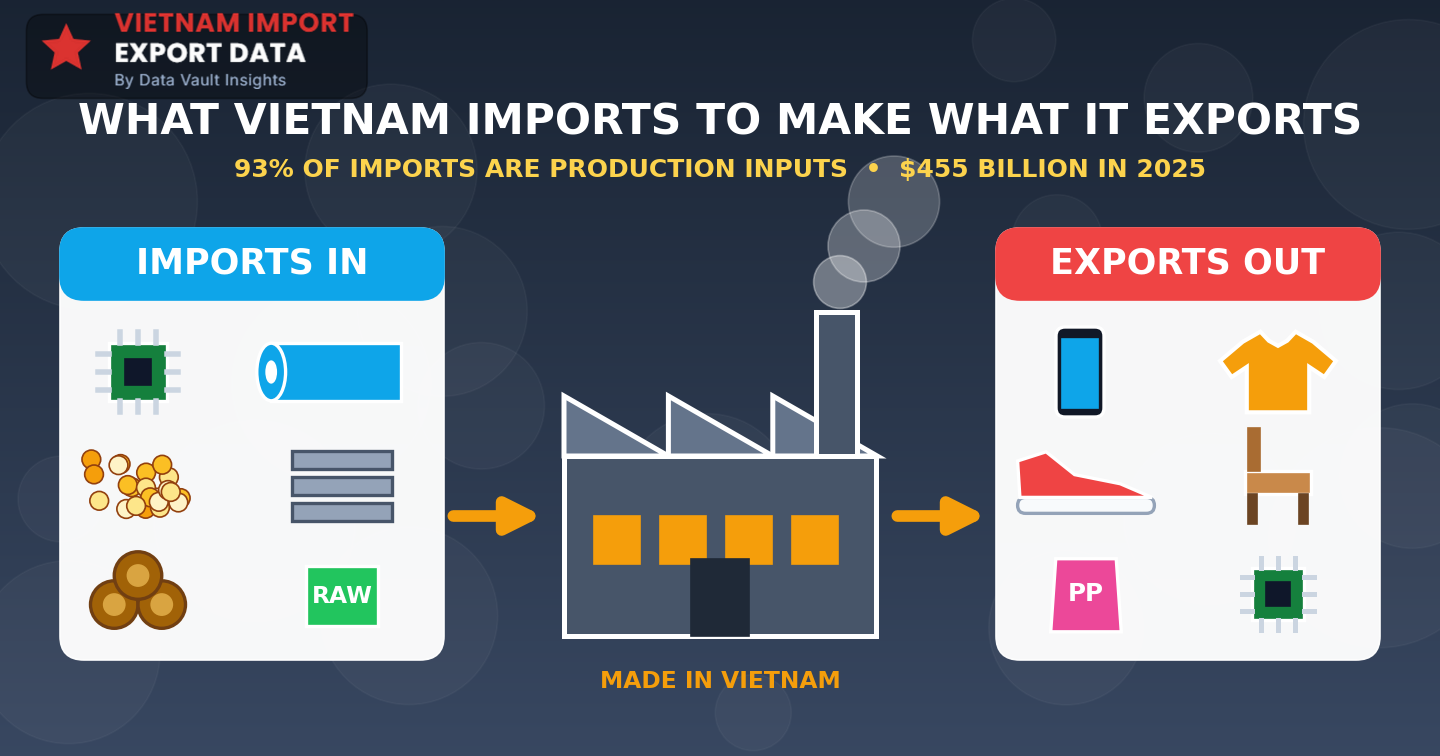
Most people look at Vietnam's exports and stop there. The better question is what had to come in first. Vietnam is an assembly and processing hub, so for almost every phone, shirt, shoe or chair that leaves its ports, a chain of imported chips, fabric, plastic resin or timber arrived earlier. The numbers show it clearly: in 2025 Vietnam imported about US$455 billion of goods, up close to 19% on the year, and more than 93% of that value was production inputs rather than consumer goods.
That is why import data is as useful as export data. It shows who supplies the factories, what they depend on and where the next opportunity is. This guide maps the main imports to the exports they become, with the HS codes you can search in Vietnam electronics import data and Vietnam plastics import data.

The Import to Export Map
Each major export has an imported input behind it. The table links them, with the HS chapters to search on the import side.
| Vietnam exports | Key imported inputs | Import HS codes | Main supplier countries |
|---|---|---|---|
| Phones and electronics | Chips, display modules, circuit boards, phone parts | 8542, 8524, 8534, 8517 | China, South Korea, Taiwan |
| Computers and machinery | Components, parts, industrial machinery | 84, 8473, 8471 | China, Taiwan, Japan, South Korea |
| Garments | Fabric, cotton, yarn, trims | 52 to 55, 60, 58, 96 | China, South Korea, Taiwan, United States |
| Footwear | Synthetic leather, soles, rubber, leather | 59, 6406, 40, 41 | China, Taiwan |
| Plastic goods | Plastic resin such as polyethylene and polypropylene | 3901 to 3907 | South Korea, China, Middle East, Thailand |
| Furniture | Timber, panels, foam, metal fittings | 44, 3921, 8302 | China, Europe, United States, Africa |
| Cashew kernels | Raw cashew nuts in shell | 0801.31 | Cambodia, Ivory Coast, Ghana |
The Biggest Imports by Value
Electronics lead by a wide margin, followed by machinery and a group of materials that feed other industries.
| Import category | 2025 value (approx.) | HS chapters | What it feeds |
|---|---|---|---|
| Computers, electronics and parts | Well over US$130 billion | 84, 85 | Phones, computers, appliances |
| Machinery and equipment | About US$55 to 61 billion, a record | 84 | Factories and construction |
| Fabric | About US$14 to 15 billion | 52 to 55, 60 | Garment factories |
| Chemicals | About US$7 billion and above | 28 to 38 | Plastics, electronics, coatings |
| Plastic resin and goods | Billions of dollars, rising fast | 39 | Packaging and manufacturing |
| Iron, steel and products | Strong growth in 2025 | 72, 73 | Construction and industry |

Electronics: Imports Run Ahead of Exports
Electronics is the clearest example of a processing hub. In 2016 Vietnam exported about US$18.5 billion of electronics, computers and parts and imported about US$27.8 billion. By 2024 exports had grown to about US$68 billion, while imports had climbed above US$110 billion. Imports keep ahead of exports because factories bring in most components, add value through assembly and testing and ship the finished product out.
| Year | Exports (US$ billion) | Imports (US$ billion) | What changed |
|---|---|---|---|
| 2016 | About 18.5 | About 27.8 | Early stage of large-scale assembly |
| 2024 | About 68 | Above 110 | Both grew more than threefold |
| 2025 | Record year | Above US$130 billion | Chips and computer parts surge |
Who Supplies the Factories
China is by far the largest source, supplying close to 40% of Vietnam's imports in 2025, up from about 37% a year earlier. South Korea and Taiwan follow, mainly with semiconductors, display parts and chemicals, and Japan and the United States fill in with machinery, precision parts, cotton and animal feed ingredients.

| Supplier country | What Vietnam mainly buys | Searchable HS codes |
|---|---|---|
| China | Electronics, machinery, fabric, plastics, steel | 85, 84, 52 to 55, 39, 72 |
| South Korea | Chips, display parts, chemicals, machinery | 8542, 8524, 29, 38, 84 |
| Taiwan | Semiconductors, display panels, components | 8542, 9013, 8534 |
| Japan | Machinery, precision parts, steel | 84, 90, 72 |
| United States | Cotton, animal feed, machinery | 5201, 2304, 84 |
What This Means for Different Readers
- Suppliers of components and materials: import records show which Vietnamese factories buy your product today, how much and from whom. These are your direct competitors and the sourcing partners of your target buyers.
- Buyers of Vietnamese goods: check what a factory imports. A garment maker that buys fabric from several mills is more flexible than one tied to a single source.
- Analysts: imports lead exports. A jump in fabric or chip imports often appears in export figures a few months later.
How to Trace an Export Back to Its Inputs
- Search export records for the product and note the top exporters.
- Look up the same companies in the import records.
- Group their imports by HS code to see the main inputs.
- Check the supplier country and price per unit for each input.
- Compare several factories to find the common suppliers behind the chain.
Frequently Asked Questions
What does Vietnam import the most?
Computers, electronics and parts, followed by machinery and equipment, then fabric, chemicals, plastics and steel.
Why does Vietnam import so much if it exports so much?
Most exports are made in factories that assemble imported parts and materials. Imports of production inputs made up more than 93% of the total value in 2025.
Which country does Vietnam import the most from?
China, which supplied close to 40% of imports in 2025, followed by South Korea and Taiwan.
Which HS code covers plastic resin?
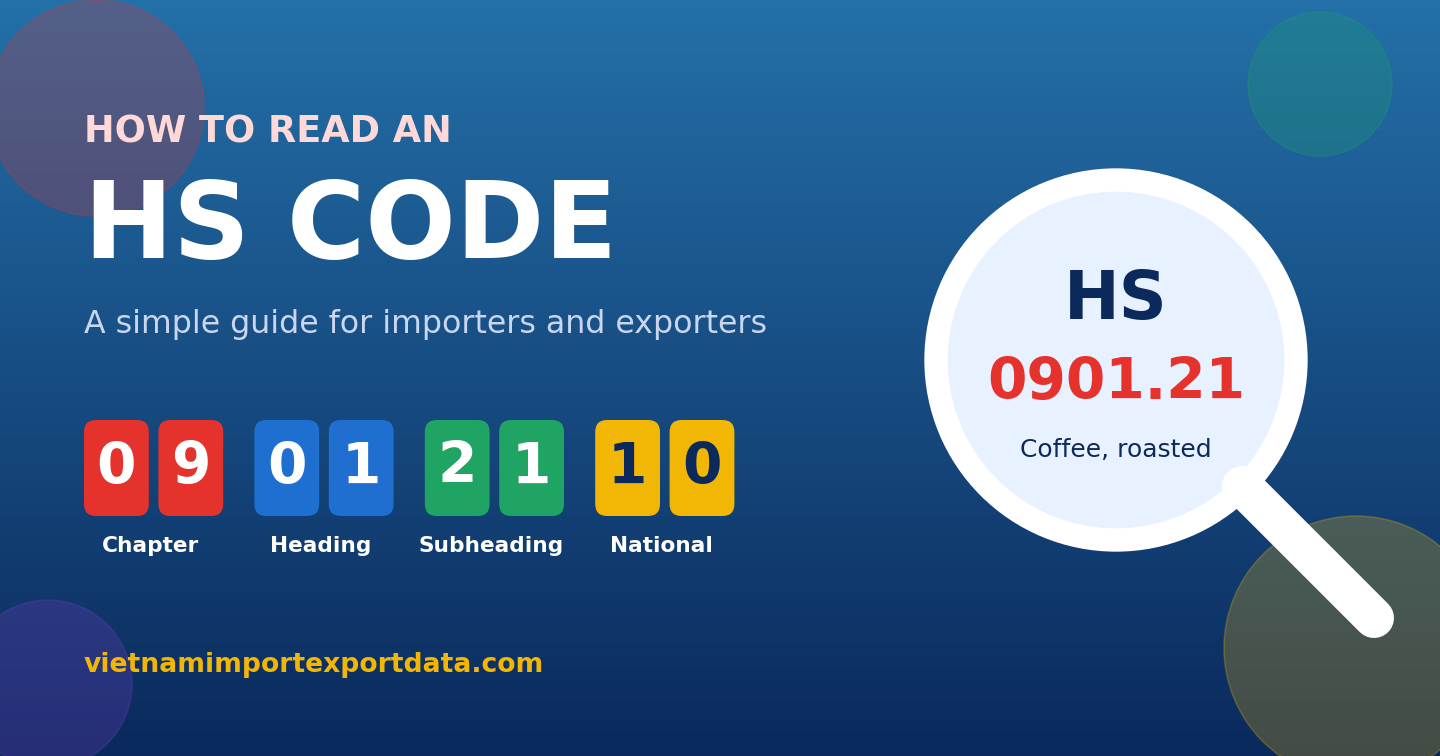
Plastics are in chapter 39. Primary forms such as polyethylene, polypropylene and PVC sit in headings 3901 to 3907.
Explore Vietnam Import Data
Want to see the companies behind these numbers? Open Vietnam electronics import data to search chips, displays and components, or Vietnam plastics import data for resin and plastic goods. If you need a specific supplier list, send us an enquiry.
Disclaimer: Vietnam Import Export Data provides shipment records and trade datasets. We do not buy or sell any products. For purchasing or selling enquiries, please contact the importers and exporters listed in our datasets.