An HS code looks like one number. It is really four decisions stacked on top of each other, made by different people for different reasons — and knowing where one stops and the next begins is what separates a trade search that finds every relevant shipment from one that quietly misses half of them.
This is a short, practical guide: what each digit does, why the same product legitimately appears under more than one code, and how to search so that neither problem costs you anything.
The four layers of an HS code
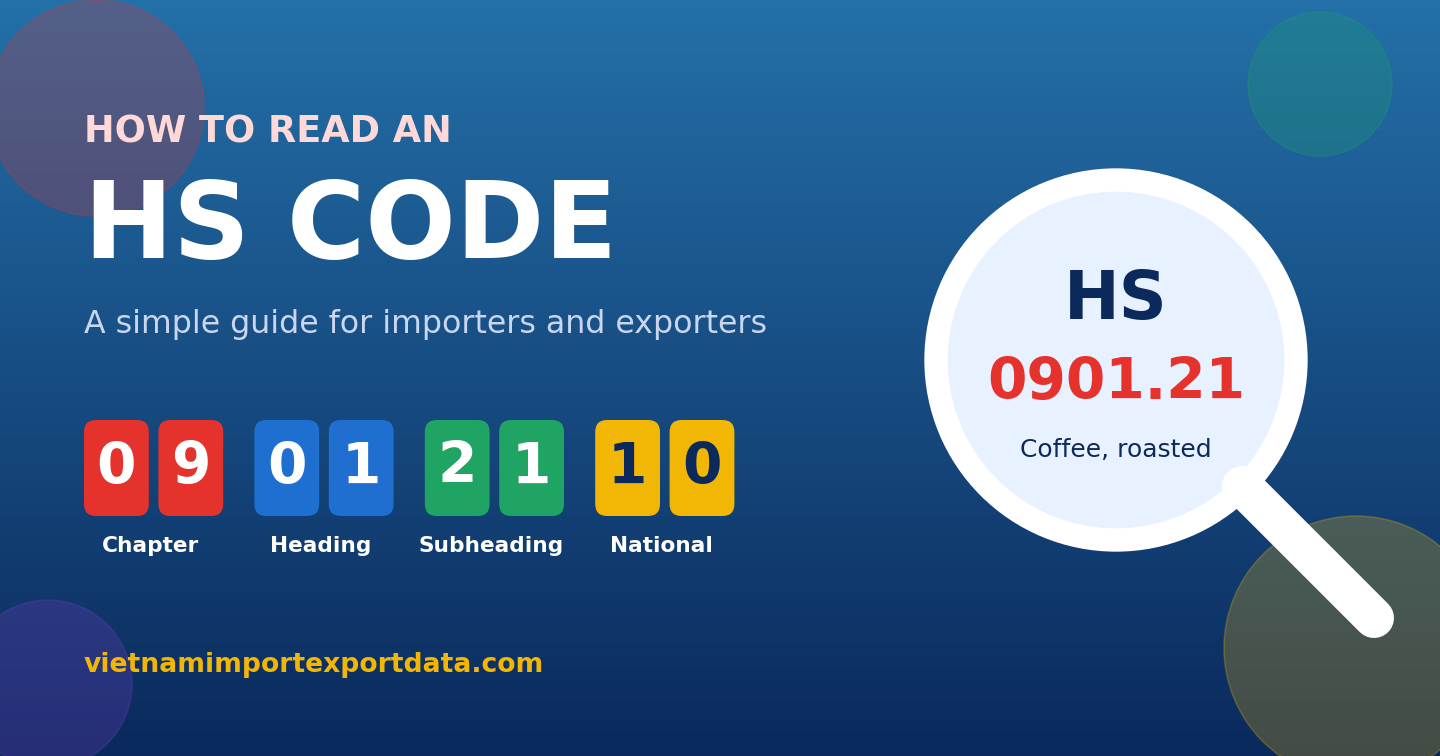
Read left to right, an HS code narrows from a broad category to a specific product. Each pair of digits is a step down.
An eight-digit code, split into the four decisions that built it
| 09 | Chapter — the broadest grouping. Digits 1–2. |
| 0901 | Heading — the product family within that chapter. Digits 1–4. |
| 090121 | Subheading — the specific product. Digits 1–6. This is where international agreement ends. |
| 09012110 | National extension — added by the importing country for its own tariff and statistics. Digits 7 onward. |
The first six digits mean the same thing everywhere the Harmonized System is used. That is the entire point of the system, and it is why a six-digit code is the safest thing to search on when you are comparing across countries.
Everything after the sixth digit is national. A country can add two digits, four, or none at all, and two countries that both extend to eight digits will not extend them the same way. An eight-digit code from one country and an eight-digit code from another are not comparable past digit six, however similar they look.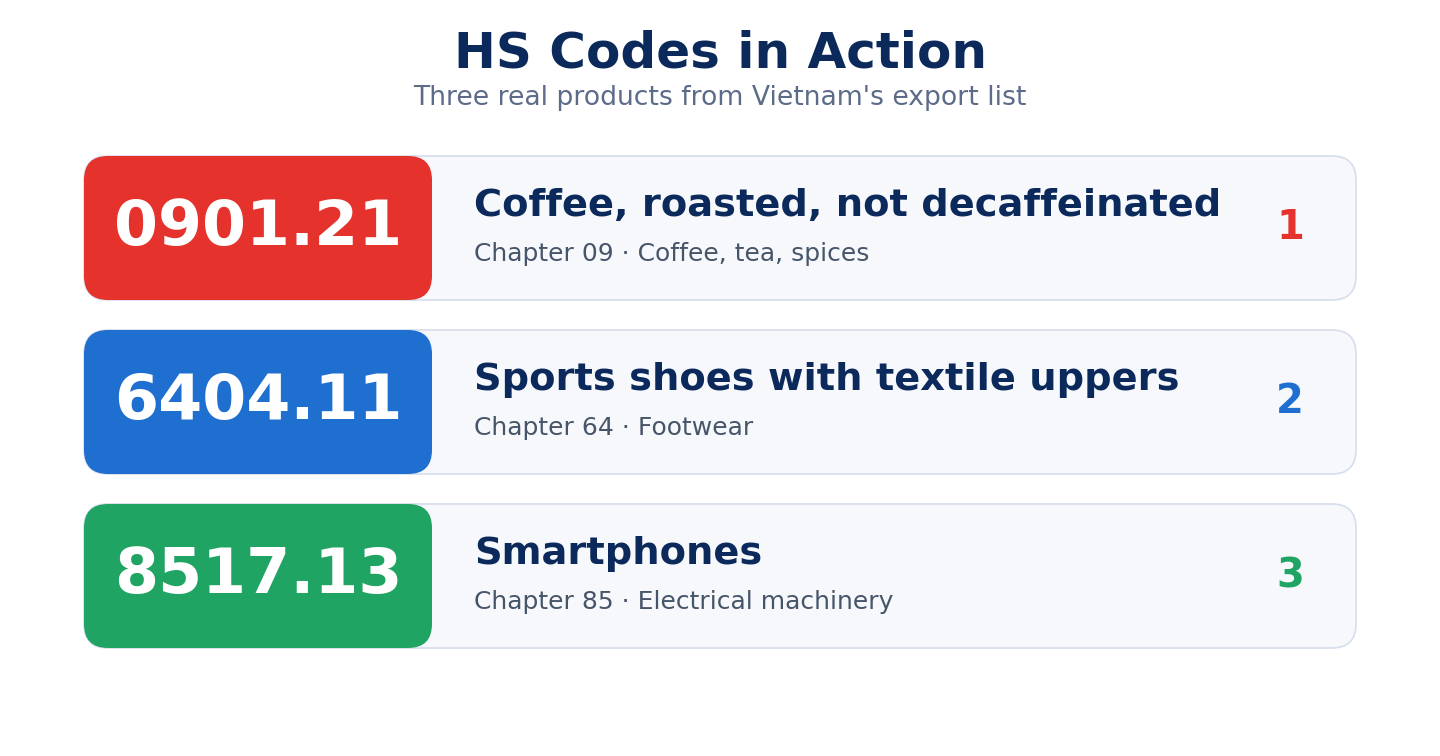
Why the same product has several codes
This is the part that costs people shipments, and it happens for four separate reasons.
The product genuinely spans codes
Coffee is the obvious example. Roasted and unroasted sit under different subheadings. Decaffeinated and not decaffeinated split again. A company that buys “coffee” is buying across at least four codes, and searching only the one they think of first returns a fraction of their own supply chain.
Processing state changes the classification
Raw material, semi-finished and finished goods are classified separately even when they are the same substance. A plastics buyer looking only at finished articles will miss every shipment of the resin those articles were made from — which is usually the more interesting half, because that is where the volume is.
Different countries extend differently
Past digit six, the codes diverge. If you are comparing what a company imports into one country against what it exports from another, only the first six digits can be lined up. Comparing eight-digit codes across borders produces confident, wrong answers.
Declarations are written by people
Two shipments of the same item, classified under the same code, can carry completely different product descriptions — different wording, different level of detail, different language. One may list a grade and a chemical reference; the other may say three words. Neither is incorrect. They were typed by different people at different companies.
How to search without missing half of it
The method
Two digits. See the whole category before narrowing, so you find out what else is in it.
Six is internationally comparable. Eight is one country’s opinion.
The code finds the category. The wording finds the specific thing inside it.
If a code has siblings, read them. Products drift between adjacent codes more than anyone expects.
What this looks li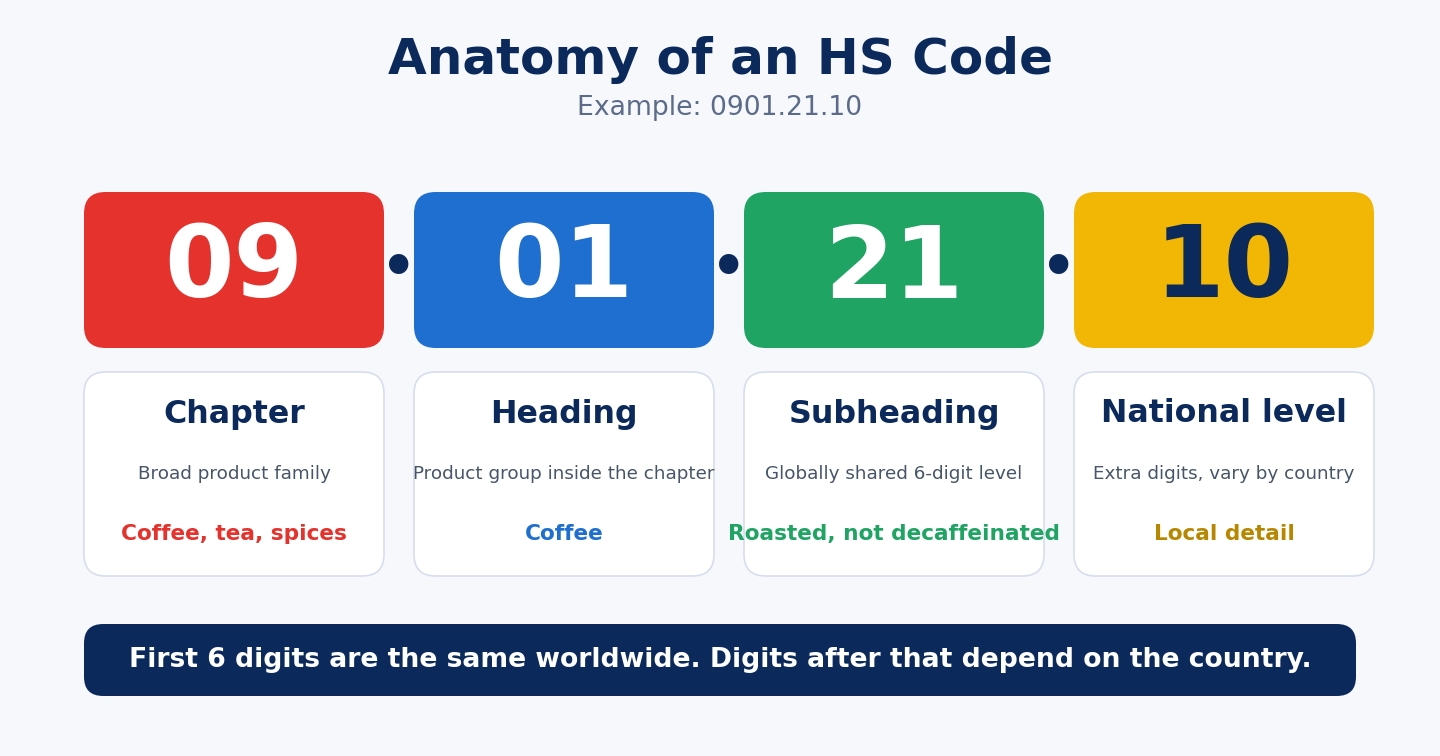 ke in practice
Say you supply a component and want to know which companies in a market already buy it.
Searching the exact eight-digit code you use at home is the intuitive move and the wrong one — that code may not exist in the destination country, and if it does it may mean something slightly different. Start at the chapter, read the headings under it, and identify the six-digit subheadings your product could plausibly fall under. There will usually be more than one.
Then read the product descriptions inside those codes. That is where you find out whether the companies appearing are buying your product or something adjacent to it — a distinction no code can make for you, because the code was never designed to.
The work takes an afternoon. The alternative is a prospect list that is confidently, invisibly incomplete.
A note on what codes cannot tell you
An HS code says what something is. It does not say how much was paid, who sold it, what quality it was, or whether the transaction repeated. Those come from the shipment record around the code, not the code itself.
This matters when reading any trade analysis built on codes alone. A summary that groups by HS code and stops there has thrown away most of what was in the underlying records — which is usually why two analyses of the same market disagree.
Where to start
If you are researching a specific product, work down from the chapter rather than up from a code someone gave you. You will find codes you did not know applied, and that is the entire value of the exercise.
Our HS code directory is open to browse without an account, and every chapter lists the products appearing under it. If you would rather skip the browsing and describe what you need, tell us the product and we will come back with the codes it appears under, along with a sample of the records.
Disclaimer: Vietnam Import Export Data provides shipment records and trade datasets. We do not buy or sell any products. For purchasing or selling enquiries, please contact the importers and exporters listed in our datasets.