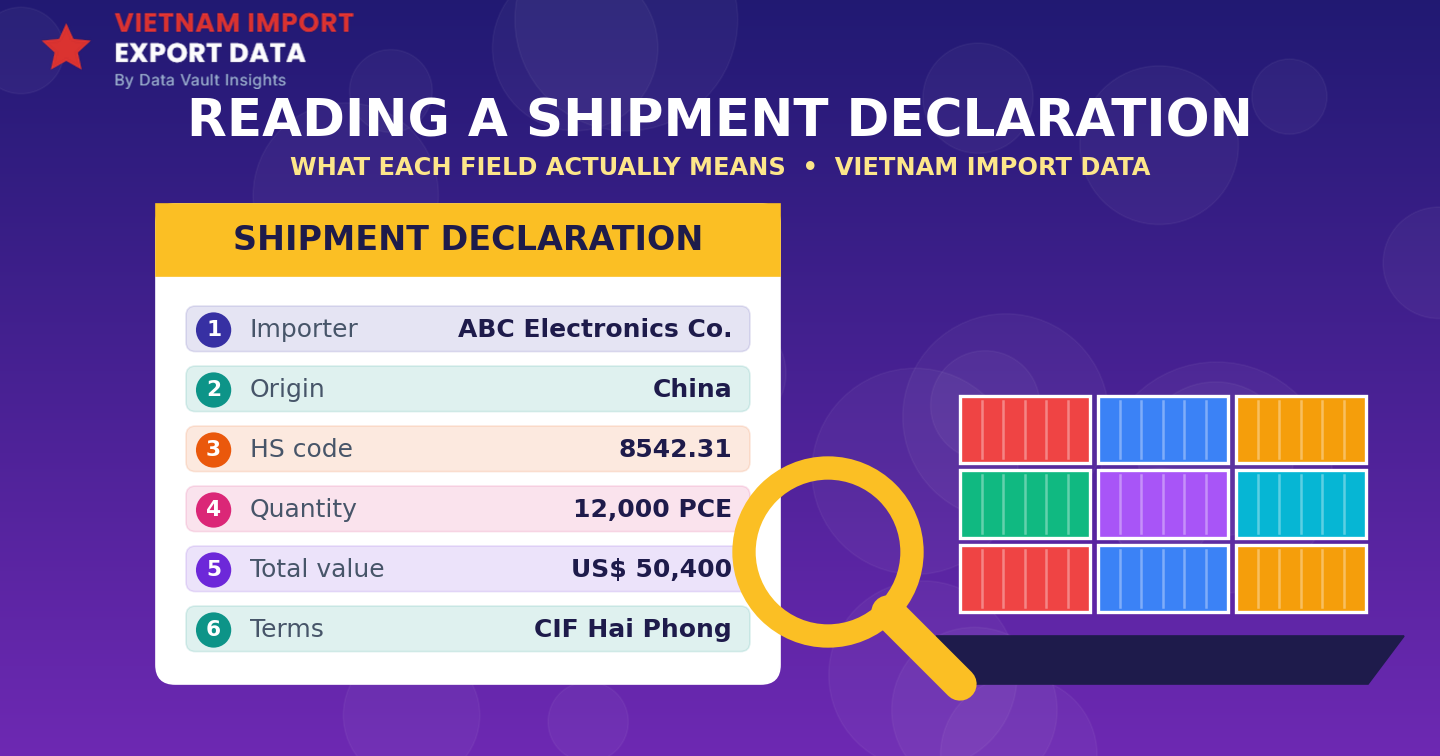
A single import record can hold fifteen or more fields, many of them written in short codes. For a buyer, a supplier or an analyst, those fields hold the answers to practical questions: who bought what, from whom, at what price and how it arrived. The problem is that nobody explains them. This guide walks through each field of a shipment declaration the way it appears in Vietnam import data, so you can read a record in under a minute.
Vietnam is a large importer. Total imports have been running above US$450 billion a year, driven by electronic components, machinery, plastics, fabrics and steel, with China, South Korea, Taiwan, Japan and the United States among the main suppliers. Every one of those shipments leaves a record behind.

A Sample Import Record
The record below is an illustrative example, not a real shipment. It shows the fields you will meet most often and what each one tells you.
| Field | Example | What it tells you |
|---|---|---|
| Date | 14 Mar 2026 | When the shipment arrived, useful for spotting seasonal buying |
| Importer | ABC Electronics Vietnam Co., Ltd | The company in Vietnam that bought the goods |
| Supplier | Sample Supplier Ltd, Shenzhen | The overseas company that sold the goods |
| Origin country | China | Where the goods were made, which can differ from where they shipped |
| HS code | 8542.31 | The product category, here electronic integrated circuits |
| Description | Integrated circuits, processors | The shipper's own words, often more specific than the code |
| Quantity and unit | 12,000 PCE | How many items, counted in pieces |
| Unit price | US$ 4.20 | The price of one unit, the most useful number for comparison |
| Total value | US$ 50,400 | Quantity multiplied by unit price |
| Terms | CIF | Who paid for freight and insurance |
| Port of discharge | Hai Phong | Where the cargo landed in Vietnam |
| Gross weight | 640 KGM | Weight of goods plus packing |
The Fields That Matter Most
1. Importer and Supplier
These two fields show the commercial link. Search an importer to see all of its suppliers, or search a supplier to see every buyer it sells to in Vietnam. A company that buys the same product from many suppliers is shopping on price. One that buys from a single supplier has a fixed relationship and may be harder to approach.
2. HS Code and Description
The HS code groups goods into categories, while the description explains what is in the box. When the two disagree, trust the description and treat the code with care. Many buyers learn this the hard way when a record filed under a broad code turns out to hold a very different product. Our guide to HS code 85 shows how wide a single chapter can be.
3. Quantity and Unit of Measure
Quantity only makes sense with its unit. A record that says 12,000 could mean pieces, kilograms or sets. Units are written in short codes, listed below.
| Unit code | Meaning | Common goods |
|---|---|---|
| KGM | Kilograms | Plastics, chemicals, food, fibre |
| TNE | Metric tonnes | Steel, grain, coal, bulk cargo |
| PCE | Pieces | Chips, parts, finished items |
| SET | Sets | Machines sold as a group, tool kits |
| MTR | Metres | Cables, fabric rolls |
| LTR | Litres | Liquids, oils, beverages |
4. Unit Price and Total Value
The unit price is the number to compare across suppliers. If the record only lists total value and quantity, divide one by the other. This single calculation catches most pricing problems.

5. Shipping Terms
Shipping terms say who paid for what. Two records with the same goods can show different prices only because one includes freight and the other does not. Reading the terms first prevents false conclusions.

| Term | Full name | What the seller covers |
|---|---|---|
| EXW | Ex Works | Goods are ready at the seller's site; the buyer arranges everything else |
| FOB | Free on Board | Seller delivers the goods onto the ship; the buyer pays sea freight |
| CIF | Cost, Insurance and Freight | Seller pays freight and insurance to the destination port |
| DAP | Delivered at Place | Seller delivers to the named place, with the buyer unloading |
6. Port and Transport Mode
Port of discharge tells you where goods entered Vietnam. Hai Phong serves the north, Cat Lai and Cai Mep serve the south, and Noi Bai airport handles high-value electronics by air. The transport mode, sea or air, is a quick way to judge urgency and cargo value.
Common Mistakes When Reading Records
- Comparing prices with different terms: a CIF price and an FOB price are not equal.
- Ignoring the unit: a price per kilogram and a price per tonne differ by a factor of one thousand.
- Trusting the HS code alone: always read the description.
- Treating origin and shipping country as the same: goods made in one country are often shipped from another.
- Judging a supplier from one record: look at a full year of shipments before drawing conclusions.
Frequently Asked Questions
What is the most useful field in an import record?
The unit price, followed by the importer and supplier names. Together they show who trades with whom and at what level.
Why does the same product show different prices?
Differences usually come from grade, quantity, shipping terms or the exchange rate on the day of shipment.
Can I find a supplier from an import record?
Yes. The supplier field lists the overseas seller, and you can search that name to see every Vietnamese buyer it serves.
Is the origin country the same as the shipping country?
Not always. Origin is where the goods were made, while the shipping country is where they left from.
See a Real Record
Want to try this yourself? Open Vietnam import data and scroll to the sample record section to see these fields on a live shipment. If you need help reading a particular record, send us an enquiry.
Disclaimer: Vietnam Import Export Data provides shipment records and trade datasets. We do not buy or sell any products. For purchasing or selling enquiries, please contact the importers and exporters listed in our datasets.