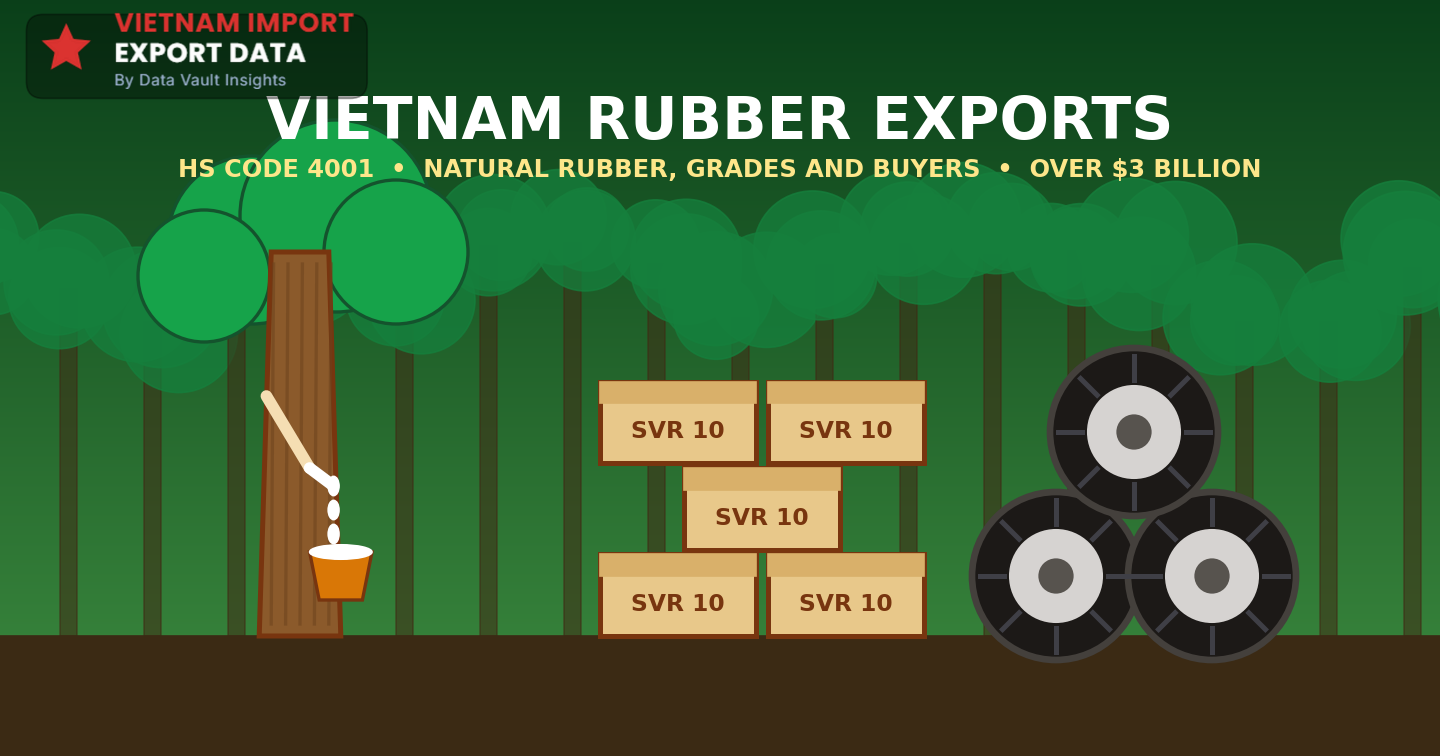
Vietnam is one of the top five natural rubber exporters in the world and the third-largest producer after Thailand and Indonesia, with around 930,000 hectares of plantations. In 2024 it shipped nearly 2 million tonnes of rubber worth US$3.42 billion, a record at the time, and in 2025 natural rubber exports stayed above US$3.2 billion even though volume slipped. Add tyres, gloves and rubberwood, and the whole rubber industry sells about US$11 billion a year abroad.
Rubber is a simple product that can look complicated in trade data: several grades, blended forms, and one dominant buyer. This guide explains the HS codes, the grade names, who buys Vietnamese rubber and how to find exporters and buyers using Vietnam rubber export data.

Vietnam Rubber Exports: Key Numbers
| Measure | Figure | Period |
|---|---|---|
| Natural rubber exported | Nearly 2 million tonnes, worth US$3.42 billion | 2024 |
| Average export price | About US$1,701 per tonne, up from US$1,350 in 2023 | 2024 |
| Natural rubber exported | About 1.7 million tonnes, US$2.89 billion, volume down 6.8% | January to November 2025 |
| Average export price | About US$1,775 per tonne, up 13% | January to August 2025 |
| Natural rubber export value | Above US$3.2 billion | Full-year 2025 estimate |
| Processed rubber products | About US$5.3 billion | 2025 estimate |
| Rubberwood exports | Above US$3.1 billion | 2025 estimate |
| Natural rubber exported | About 464,000 tonnes, US$861 million, average US$1,856 | January to April 2026 |
Prices have been the main driver. In 2024 volume fell about 6% while value rose 18%. In 2025 volume slipped again, but a higher average price held value close to US$3 billion. Early 2026 data shows the average price easing about 4% from the year before, and some forecasts see full-year 2026 natural rubber exports near US$3.15 billion.
HS Codes for Rubber
Natural rubber sits in HS heading 4001, but Vietnam also ships a large volume of compounded or blended rubber under 4005, so a search of 4001 alone misses a big part of the trade.
| HS code | What it covers | Typical products |
|---|---|---|
| 4001.10 | Natural rubber latex | Concentrated latex for gloves and foam |
| 4001.21 | Smoked sheets | RSS grades such as RSS 3 |
| 4001.22 | Technically specified natural rubber | SVR 3L, SVR 10, SVR 20, SVR CV60 |
| 4001.29 | Other natural rubber | Crepe and other forms |
| 4005 | Compounded rubber, unvulcanised | Mixed or blended rubber, largely sold to China |
| 4002, 4003 | Synthetic and reclaimed rubber | Related materials for manufacturers |
| 4011, 4015, 4016 | Tyres, gloves and other rubber articles | Processed products |
In recent years more of Vietnam's rubber has moved into blended forms. In the first quarter of 2025 blend exports were worth about US$467 million, almost all of it going to China, and blended rubber made up over 63% of volume.
Understanding Rubber Grades
| Grade in the record | What it is | Used for |
|---|---|---|
| SVR 3L | Standard Vietnamese Rubber, light colour, very low dirt | High-quality products and latex-like uses |
| SVR 10 | General-purpose technically specified rubber | Tyres and most industrial products |
| SVR 20 | Slightly lower cleanliness grade | Tyres and lower-cost parts |
| SVR CV60 | Constant viscosity grade | Products needing uniform processing |
| RSS 3 | Ribbed smoked sheet | Tyres, footwear soles and other products |
| Latex 60% DRC | Liquid latex with 60% dry rubber content | Gloves, balloons, foam |
| Mixed or blended rubber | Natural rubber mixed with other materials | Mostly shipped to China for tyre makers |
Who Buys Vietnamese Rubber
One buyer dominates. In 2024 China took about 1.5 million tonnes worth US$2.4 billion, which was around 68 to 70% of Vietnam's rubber export revenue. China's tyre industry, boosted by electric and hybrid vehicle growth, is the main reason. India, the European Union and South Korea follow, and in early 2026 Indonesia and India were the next two largest markets after China.

| Market | Share of 2024 exports | What to know |
|---|---|---|
| China | About 67.6% | Buys mostly blends and technically specified rubber for tyres |
| India | About 7.7% | Growing tyre and glove makers |
| European Union | About 6% | Demanding documentation and traceability |
| South Korea | About 2.5% | Tyre and industrial buyers |
| Early 2026 pattern | China 66.1%, Indonesia 6.6%, India 6% | China still above 65% |
That heavy reliance on one market is both the strength and the risk of Vietnam's rubber trade. For new suppliers outside China, the less crowded markets are often the easier ones to enter.
The Import Side: Vietnam Also Buys Rubber
Vietnam is a net exporter but also a large importer. In 2024 it imported about 1.9 million tonnes worth around US$3 billion, mostly raw rubber from Cambodia, which supplied about 80% of the volume, and from Laos. In the first four months of 2025, imports reached about 540,000 tonnes worth over US$945 million. Cambodia led with about 191,000 tonnes, followed by China with about 79,000 tonnes and South Korea with about 62,000 tonnes.
| Supplier | Jan to Apr 2025 volume | Value | Average price per tonne |
|---|---|---|---|
| Cambodia | About 191,000 tonnes | Over US$275 million | About US$1,450 |
| China | About 79,000 tonnes | Over US$151 million | About US$1,927 |
| South Korea | About 62,000 tonnes | About US$106 million | About US$1,711 |

How to Find Rubber Exporters in the Records
- Search HS 4001 and, separately, 4005 for exports over the last 12 months.
- Filter by grade using the words "SVR 10", "SVR 3L", "RSS 3" or "latex".
- Group by exporter and rank by tonnes shipped.
- Check the buyers. Exporters that sell to India, Korea or Europe, and not only to China, usually have a broader range of quality documents.
- Compare price per tonne for the same grade and shipping terms.
- Verify the company with our guide on checking a supplier before you contact them.
What to Watch in 2026
- Price pressure: early 2026 prices were about 4% below the previous year, which squeezes revenue.
- Dependence on China: any change in Chinese tyre demand affects almost all of Vietnam's rubber trade.
- Value added: more rubber is going into gloves, tyres and technical parts, and processed products are now larger than raw rubber exports.
- Imports for processing: Cambodia and Laos remain key to Vietnamese factories.
Frequently Asked Questions
What is the HS code for natural rubber?
Natural rubber is classified under HS 4001. Technically specified grades such as SVR 10 fall under 4001.22.
How much rubber does Vietnam export?
Close to 2 million tonnes a year, worth over US$3 billion, with 2024 at US$3.42 billion and 2025 above US$3.2 billion.
Who is the biggest buyer of Vietnamese rubber?
China, which takes about two thirds of the value.
What does SVR mean?
Standard Vietnamese Rubber. It is a family of technically specified natural rubber grades, such as SVR 3L, SVR 10 and SVR 20.
Search Rubber Export Data
Ready to find rubber exporters or buyers? Open Vietnam rubber export data to search HS 4001 and 4005 by exporter, buyer, grade and price per tonne. If you need help matching a grade to the right record, send us an enquiry.
Disclaimer: Vietnam Import Export Data provides shipment records and trade datasets. We do not buy or sell any products. For purchasing or selling enquiries, please contact the importers and exporters listed in our datasets.