Every sourcing project starts the same way: you need a list of possible suppliers. The traditional answer is a supplier directory, a website where companies list themselves with a profile, a product range and a contact form. Directories are convenient and easy to browse, and for many years they were the only option.
They also share one weakness. Almost everything in a directory is written by the supplier. A company can describe itself as a premium manufacturer with twenty years of experience without showing a single shipment. Trade data works the other way around. It records what was shipped, to whom, in what quantity and at what price. This guide explains the difference and shows when each tool is the right one. You can try the data side in our directories section or start from the homepage.
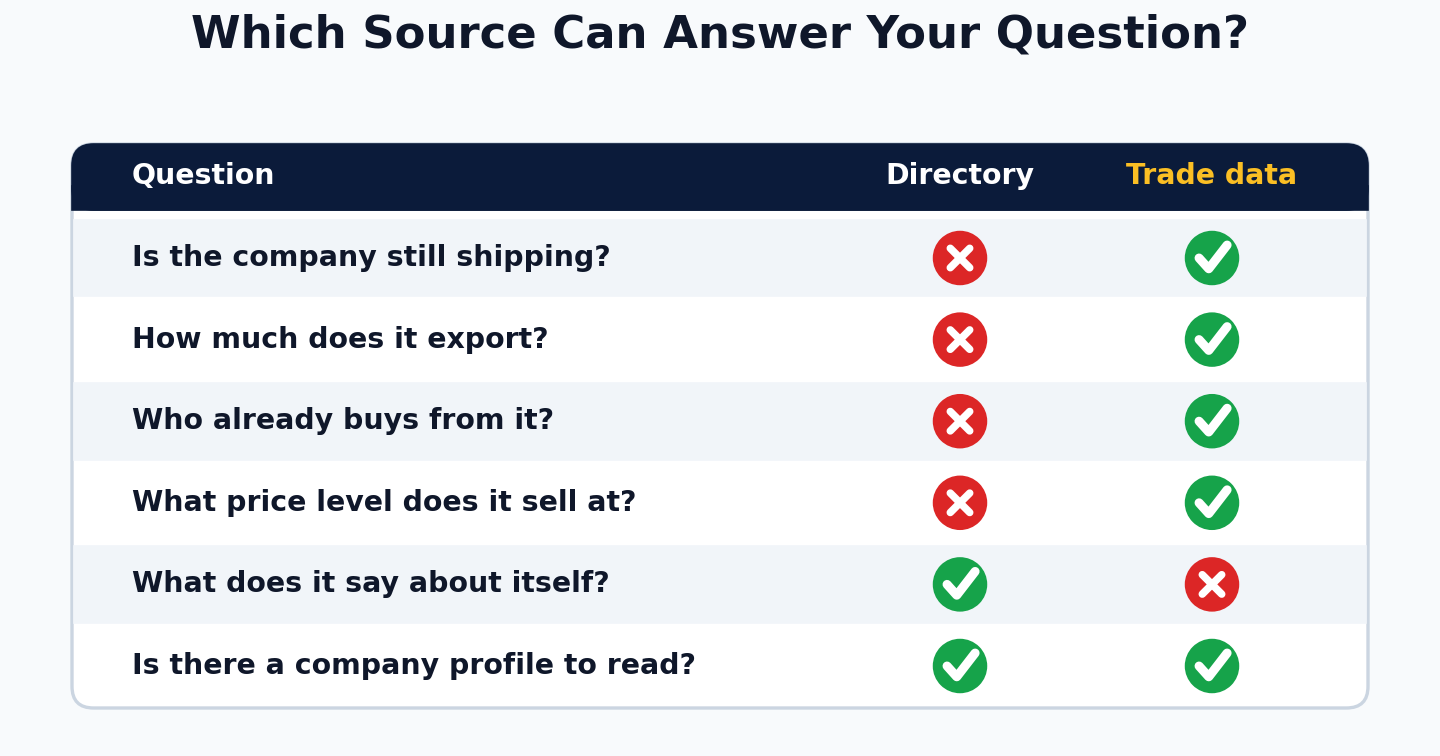
Directory vs Trade Data: Side by Side
| Question you need answered | Supplier directory | Trade data |
|---|---|---|
| Is the company still active? | Not shown; listings can stay online for years | Date of the last shipment |
| How much does it export? | Self-reported ("large capacity") | Shipment count, quantity and value |
| Who already buys from it? | Logos or claims, rarely proof | Buyer countries and importer names |
| What does it charge? | "Contact us for price" | Unit price from real shipments |
| What does it really make? | Whatever it chooses to list | HS codes and product descriptions |
| Is it a factory or a trader? | Both call themselves manufacturers | Product range and shipment pattern reveal the difference |
| How do I contact it? | Contact form or listed details | Company name and address from records |
Five Reasons Trade Data Is More Reliable
1. It records actions, not claims
A shipment record exists because goods really moved. There is no marketing copy to write and no profile to polish. If a company says it exports to Europe, the data either shows European buyers or it does not.
2. It shows how recent the activity is
A directory entry can be five years old. A trade record has a date. Seeing a shipment from last month tells you more than any profile page.
3. It reveals the price level
Directories rarely show prices. Trade records let you work out the unit price from value and quantity, so you know whether a quote is realistic before you negotiate.
4. It exposes the real product range
Many directory profiles list dozens of products because listing is free and broad. Records show the products a company actually ships. A supplier that lists footwear, furniture and coffee but only ships coffee is a coffee exporter.
5. It is harder to fake
Anyone can create a listing in a few minutes. Building a record of regular shipments to real buyers takes years.
What a Directory Still Does Well
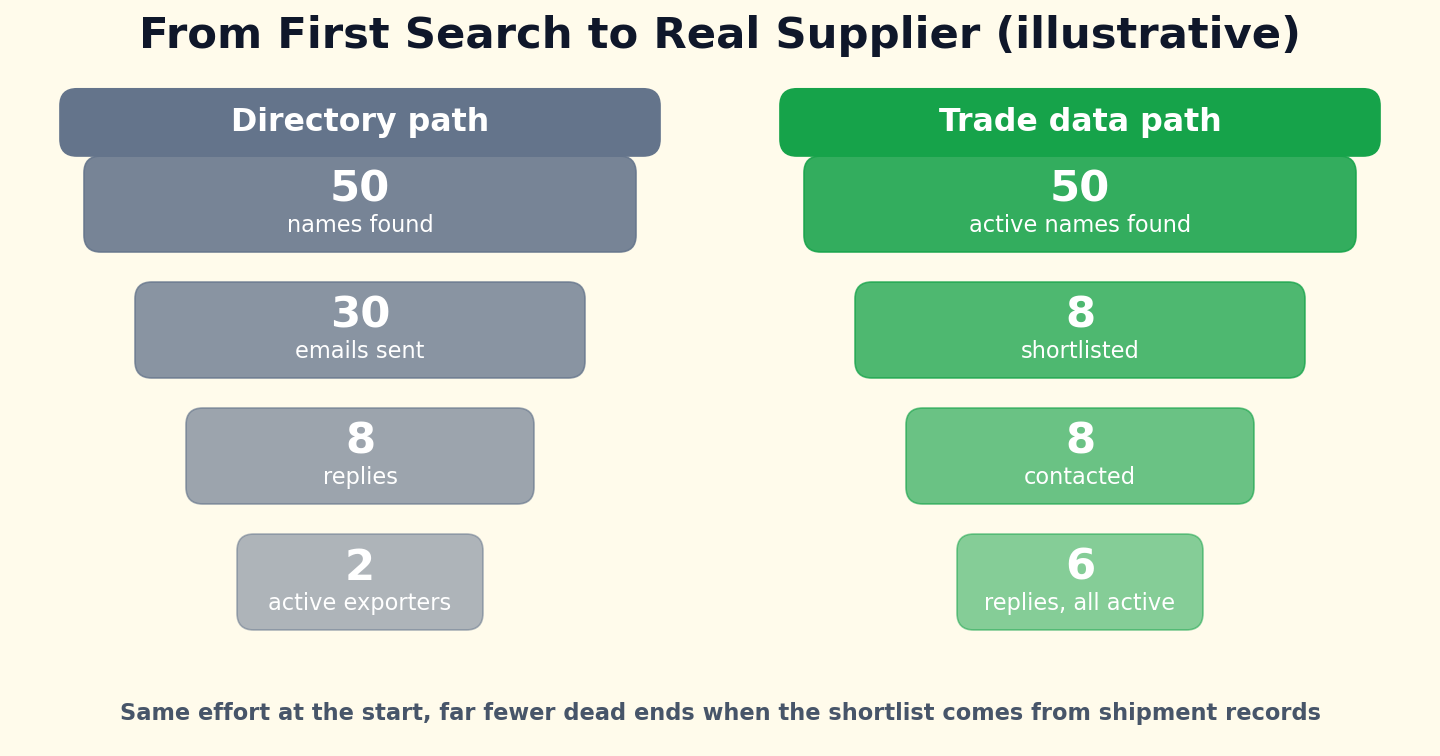
Directories are not useless. They are good at discovery, especially for a product category you are exploring for the first time. They also tend to carry a company profile, a description of services and contact details in one place. The mistake is treating a listing as proof. The sensible approach is to use a directory to find names and trade data to check them.
| Situation | Best tool | Why |
|---|---|---|
| Exploring a new product category | Directory or general search | Quickest way to see who exists |
| Shortlisting suppliers | Trade data | Filters out inactive and one-off names |
| Comparing quotes | Trade data | Gives a price benchmark from real shipments |
| Reading about services and certificates | Directory profile | Companies describe capabilities there |
| Checking a name you already have | Trade data | Confirms activity, buyers and volume |
| Studying a market | Trade data | Shows total volume, growth and leading exporters |
What Trade Data Cannot Tell You
Trade data is evidence of activity, not a guarantee of quality. It does not show how a factory treats its workers, how it handles complaints or whether its product meets your specification. It can also miss very new companies that have not shipped yet. That is why the best approach is a combination: records to check the facts, then samples, a factory visit or a third-party inspection to check the product.
A Three-Step Workflow That Combines Both

- Discover. Use a directory or a search to build a long list of companies in your product category.
- Verify. Look up each name in trade records. Check the last shipment date, the shipment pattern, the buyers and the unit price. Drop anyone who is inactive or inconsistent. Our guide on checking a supplier before you contact them shows the seven checks in detail.
- Contact. Write to the verified few. Because you know their products and buyers, you can ask specific questions rather than send a generic request.
Frequently Asked Questions
Is trade data better than a supplier directory?
For checking whether a supplier is active, how much it ships and what it charges, yes. For discovering names and reading company profiles, a directory can still help. Using both gives the best result.
Can a supplier pay to appear in trade data?
No. Records reflect shipments that took place, so a company cannot buy its way into them.
What if a supplier has no trade records?
It may be new, a small trader or shipping under another name. Try name variants and search by product code before ruling it out.
How fast can I verify a supplier with trade data?
About five minutes for a basic check: last shipment date, shipment pattern, buyers and price level.
Try It Yourself
Ready to check your next supplier with real shipment records? Open the directories section to find companies, then look up their activity, buyers and prices. You can also start from the homepage and search by product, company or HS code. If you need help building a shortlist, send us an enquiry.
Disclaimer: Vietnam Import Export Data provides shipment records and trade datasets. We do not buy or sell any products. For purchasing or selling enquiries, please contact the importers and exporters listed in our datasets.